Blog
What Is in NeuroPulse Pro? The Full Ingredients List Explained
Quick answer
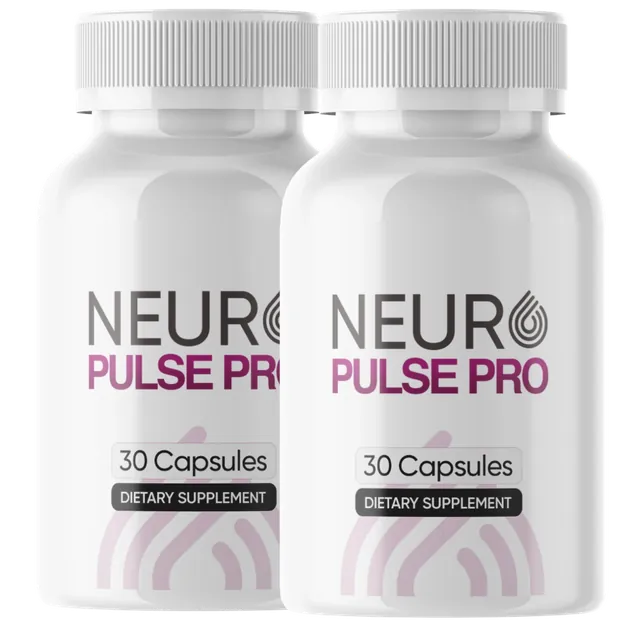
NeuroPulse Pro lists 16 vitamins and minerals plus a 179.5 mg blend of 11 plant ingredients. The B vitamins to know are thiamin (3 mg), B6 (4 mg), B12 (6 mcg) and biotin (2,500 mcg). Fillers are rice flour, hypromellose, magnesium stearate and silicon dioxide. The capsule contains soy, and herb amounts are not published.
Key facts
- Serving size: 1 capsule. Servings per bottle: 30.
- 16 vitamins and minerals, each with an amount and %DV.
- One proprietary blend of 11 ingredients, 179.5 mg in total, with no Daily Value and no single amounts.
- Fillers and shell: rice flour, hypromellose (the plant capsule), vegetable magnesium stearate and silicon dioxide.
- Allergen: Contains soy, from the plant sterols in the blend.
- Not on the label: alpha-lipoic acid, acetyl-L-carnitine, benfotiamine and methylcobalamin.
- No vegan, gluten-free or non-GMO claim is printed.
What is on the NeuroPulse Pro label, nutrient by nutrient?
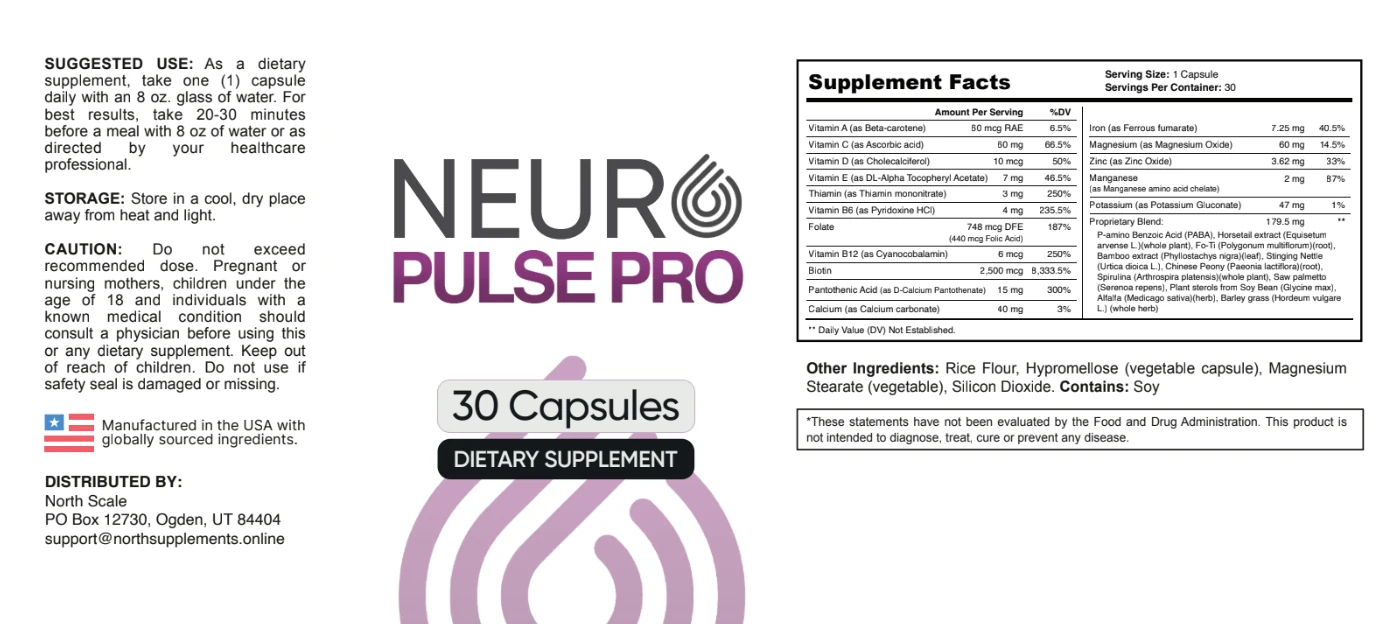
This is the Supplement Facts panel for one capsule, copied as printed. The %DV numbers include the decimals the label shows.
This NeuroPulse Pro ingredients list follows the label, so you can hold your bottle next to it.
| Nutrient | Form | Amount | %DV |
|---|---|---|---|
| Vitamin A | beta-carotene | 60 mcg RAE | 6.5% |
| Vitamin C | ascorbic acid | 60 mg | 66.5% |
| Vitamin D | cholecalciferol | 10 mcg | 50% |
| Vitamin E | DL-alpha tocopheryl acetate | 7 mg | 46.5% |
| Thiamin (B1) | thiamin mononitrate | 3 mg | 250% |
| Vitamin B6 | pyridoxine HCl | 4 mg | 235.5% |
| Folate | 440 mcg folic acid | 748 mcg DFE | 187% |
| Vitamin B12 | cyanocobalamin | 6 mcg | 250% |
| Biotin | form not listed | 2,500 mcg | 8,333.5% |
| Pantothenic acid | D-calcium pantothenate | 15 mg | 300% |
| Calcium | calcium carbonate | 40 mg | 3% |
| Iron | ferrous fumarate | 7.25 mg | 40.5% |
| Magnesium | magnesium oxide | 60 mg | 14.5% |
| Zinc | zinc oxide | 3.62 mg | 33% |
| Manganese | manganese amino acid chelate | 2 mg | 87% |
| Potassium | potassium gluconate | 47 mg | 1% |
| Proprietary blend | 11 ingredients | 179.5 mg | No DV set |
Which B vitamins are in NeuroPulse Pro, and what do they do?
Six B vitamins are on the panel. Three have a direct link to nerves, and the other three round out the B family.
What do the other vitamins and minerals add?
Vitamins A, C, D and E give a general antioxidant and bone-support base, as in a daily multivitamin. The amounts are small to moderate: none passes 100% DV.
Seven minerals follow. Most doses are small. Calcium at 40 mg is 3% DV and potassium at 47 mg is 1% DV, so they will not cover your needs. Magnesium is 60 mg as oxide, a common low-cost form. Zinc is 3.62 mg and manganese is 2 mg.
Iron is the mineral that calls for care in the house. At 7.25 mg it is below the adult upper limit of 45 mg, but it is dangerous for young children. (NIH ODS, iron)
What is in the 179.5 mg blend?
Eleven ingredients share one total weight. The label names each and the plant part, but gives no single amount. In label order they are:
| Ingredient | What it is | Amount |
|---|---|---|
| PABA | A compound once grouped with the B vitamins; you do not need it from food | Not published |
| Horsetail | A fern-like plant used traditionally as a mild diuretic | Not published |
| Fo-ti | A Chinese root, also called He Shou Wu; linked to rare liver injury (LiverTox, 2020) | Not published |
| Bamboo extract | A leaf extract; human research is scarce | Not published |
| Stinging nettle | A leafy herb often made into teas | Not published |
| Chinese peony | A root used in traditional Chinese formulas | Not published |
| Spirulina | A blue-green alga sold as a protein-rich powder | Not published |
| Saw palmetto | A palm berry extract, mostly studied for prostate symptoms (NCCIH, 2025) | Not published |
| Plant sterols | Plant compounds that resemble cholesterol; the source of the soy allergen | Not published |
| Alfalfa | A legume, often eaten as sprouts | Not published |
| Barley grass | Young barley leaves dried into a green powder | Not published |
Shared evenly, each would get about 16 mg. The label does not say they share evenly, so treat that as a rough picture only. The point is that each herb is likely a small amount, and that you cannot compare it with a research dose.
What are the other ingredients and the allergen line?
- Rice flour: a filler that brings each capsule to a steady size.
- Hypromellose: the capsule shell, a plant material (cellulose).
- Magnesium stearate (vegetable): lets the powder run smoothly in the filling machine.
- Silicon dioxide: keeps the powder from clumping.
The label then prints "Contains: soy." If you have a soy allergy, skip the product. No artificial color, sweetener or flavor is printed, and no gluten-free, vegan or non-GMO claim is made.
How do you read a panel like this one?
Start with the serving
One capsule. Every number applies to that one capsule.
Watch the units
A milligram (mg) is 1,000 times larger than a microgram (mcg).
Read the %DV
Under 100% is less than a full day of that nutrient. Over 100% is more. A high percent is not a danger signal by itself.
Find the blend line
A blend gives one total weight. The single amounts stay private.
Read the small print
Other ingredients and allergens sit below the box.
How does it compare with a multivitamin you already own?
It overlaps a lot. Read the rows and you see a daily multivitamin with more B vitamins than usual. The herbal blend is the main thing a plain multivitamin would not have.
Nerve pain supplements ingredients vary a great deal between brands, so compare labels line by line rather than by the front of the bottle.
If you already take one, line up both labels and write down the B6, biotin, folic acid, iron and vitamin D from each. Add them. Then ask a pharmacist if the totals suit you. Two multi-style products together often double the iron and biotin.
What is not on the label?
- Alpha-lipoic acid
- Acetyl-L-carnitine
- Benfotiamine (the thiamin here is mononitrate)
- Methylcobalamin (the B12 here is cyanocobalamin)
- The amount of each blend herb
- A lab report or a study of the finished formula
Knowing this helps you compare fairly. It also means you should not buy the capsule expecting those ingredients.
Frequently asked questions
What are the ingredients in NeuroPulse Pro?
Sixteen vitamins and minerals, a 179.5 mg blend of 11 plant and other ingredients, and four other ingredients: rice flour, hypromellose, vegetable magnesium stearate and silicon dioxide.
What is the amount of each herb in the blend?
That is not published. The label prints one total, 179.5 mg, for all 11 blend ingredients combined.
Does NeuroPulse Pro contain soy?
Yes. The label says Contains: soy. Soy enters the capsule through the plant sterols in the blend.
Is the B12 in NeuroPulse Pro a high dose?
No. It is 6 mcg, or 250% of the Daily Value, which is modest next to many B12 products.
Why does biotin show 8,333.5%?
The Daily Value for biotin is small, so 2,500 mcg looks huge as a percent. The practical issue is that biotin can distort some lab tests.
Is NeuroPulse Pro vegan?
The label does not say. The shell is hypromellose, a plant material, and the magnesium stearate is marked vegetable, but no vegan claim is printed.
References
- NIH Office of Dietary Supplements (accessed 2026). Thiamin: Fact Sheet for Health Professionals.
- NIH Office of Dietary Supplements (accessed 2026). Vitamin B6: Fact Sheet for Health Professionals.
- NIH Office of Dietary Supplements (accessed 2026). Vitamin B12: Fact Sheet for Health Professionals.
- U.S. Food and Drug Administration (2022). Biotin Interference with Troponin Lab Tests.
- NIH Office of Dietary Supplements (accessed 2026). Iron: Fact Sheet for Health Professionals.
- LiverTox, National Institute of Diabetes and Digestive and Kidney Diseases (2020). Polygonum Multiflorum (Fo-Ti).
- National Center for Complementary and Integrative Health (2025). Saw Palmetto: Usefulness and Safety.
Our view
The label is clear where it matters most for safety and dose: every vitamin and mineral has a number. That is better than many supplement labels.
The blend is the opaque part. You know the names and the total weight, and nothing else. Treat it as an unmeasured extra, not as the reason to buy.
Read the panel against your own bottle, count the nutrients you already take, and bring the label to your doctor or pharmacist. Those three steps tell you more than any ad.
A note on status: NeuroPulse Pro is not FDA approved, and no supplement is. Questions about how the ingredients fit your health go to your doctor. These statements have not been evaluated by the Food and Drug Administration. This product is not intended to diagnose, treat, cure, or prevent any disease.
Read next
Last updated